
Insights Journal

Research-informed.  Experience-tested. Community-focused.

Thoughtful perspectives on housing, stewardship, leadership, and the communities we serve.


Welcome


At Champion Investments, we believe real estate is about far more than transactions. Housing influences families, education, local economies, and the communities we call home. 


Through the Insights Journal, we explore the ideas, research, and experiences that shape housing, property management, stewardship, and community life. Our hope is to encourage thoughtful conversations, share practical knowledge, and continue learning alongside the communities we serve. 


We believe the best ideas begin with curiosity, are strengthened through research, and become meaningful when shared with others. 


Housing Matters


Housing, community, and the places where life unfolds. 

View Series 


Housing influences far more than where we live. it shapes our opportunities, relationships, communities, and the rhythms of everyday life. This series explores housing through the lenses of education, stewardship, leadership, and community


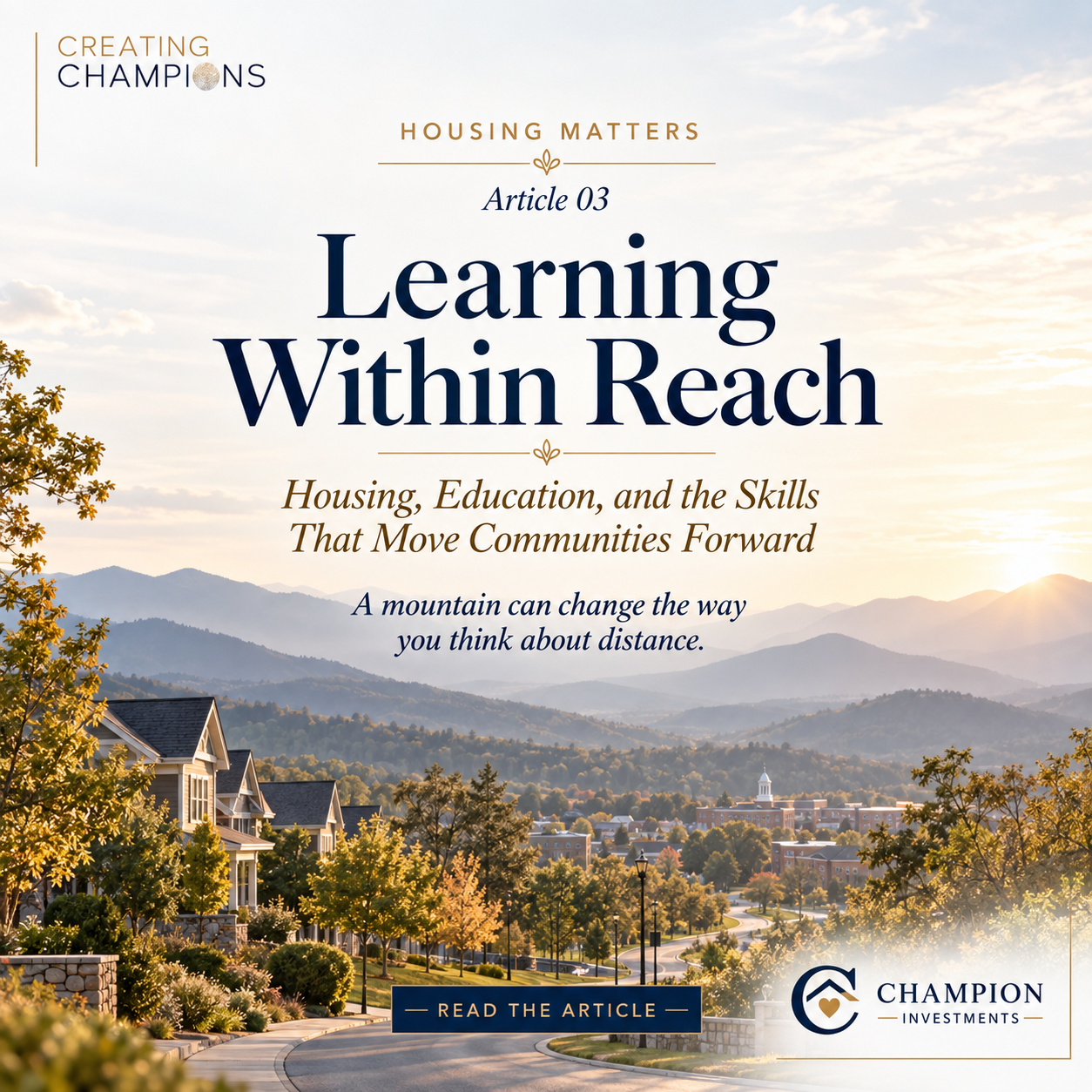
Article 03: Learning Within Reach

Housing Matters | Article 03


Learning Within Reach


Housing, Education, and the Skills That Move Communities Forward


A mountain can change the way you think about distance.


During a recent visit to Beech Mountain, North Carolina, I found myself thinking about education differently. From the top of the mountain, the view seems to erase boundaries—ridgelines unfold into distant communities and, on a clear day, even neighboring states.


But what looks close from above can feel very different by road.


The setting is beautiful and expansive, yet that same geography creates practical challenges. Roads wind. Travel takes time. A trip to the grocery store or a restaurant can become a journey, much less a commute to a classroom, training center, or college campus.


I began thinking about the parent who wants to return to school.


Maybe she is a nurse hoping to advance to the next level of practice. My own mother returned to school after we had all graduated. She worked, attended classes, and ultimately earned her nursing degree. Was it easy? No. Did she persevere through fear, competing responsibilities, and the demands of everyday life? Absolutely.


But there was another factor at work: proximity.


How far did she have to travel to gain the skills she needed? Was education close enough to fit within the rest of her life? And how might that distance have helped—or hindered—her ability to reach her goal?


The same questions apply to many different people and many different seasons.


Someone may need a new credential because an industry is changing—or because technology within an existing career has changed. Someone else may want to learn a trade, earn a license, complete continuing education, gain a skill required for a promotion, or simply learn a new hobby.


The question is no longer simply:  Is education available?


Perhaps the better question is:  Is learning within reach?


From Where Life Begins to What Comes Next


In the first Housing Matters article, Where Life Begins, we considered housing as the place from which so much of everyday life unfolds.


In The Housing Ladder, we explored another idea: our housing needs change because our lives change. A first apartment, a growing family, relocation, simplifying, or aging in place may each require something different. The ladder represents seasons, not success.


Education fits naturally into that conversation because sometimes the next season requires something we cannot see from the outside of a house:


A new skill.


A career change. A certification. A degree. Training on new technology.


Housing gives us a place to land. Education can help prepare us for where we go next.


Education Has Changed


When we talk about housing and education, we often begin with proximity to elementary, middle, and high schools.


That still matters.


But education today extends far beyond the traditional school day.


Technology has changed not only how we learn, but also how quickly the skills required for work can change. A parent may complete part of a credential online after children are asleep. Specialized training may take place inside a manufacturing facility as equipment, processes, and technology evolve. And learning no longer has to mean committing immediately to a traditional two- or four-year degree.


This is where community colleges often become an important bridge.


Positioned close to the communities they serve, they can connect education with local workforce needs through short-term credentials, technical programs, apprenticeships, continuing education, and pathways into further study.

In North Carolina, that can mean everything from welding, machining, and apprenticeships to associate-degree nursing programs, short-term credentials, and continuing education. It can also mean taking education directly into the workplace—helping manufacturers train employees on new technology or develop supervisors and emerging leaders who connect production teams with senior leadership.


In many ways, community colleges help bring learning closer to the learner.


But bringing education closer solves only part of the equation.


The learner still has to live somewhere.


Availability Is Not the Same as Accessibility


A course can technically be available and still be difficult to access.


Imagine a parent considering an evening certification program.


The program exists.


But can she get there after work?  Who will care for the children? How far is the drive? When does childcare close?  Can part of the program be completed online?  Does the home have reliable broadband?  Will the credential connect to an actual job nearby?


Suddenly, education is no longer one decision.  It becomes an ecosystem of decisions.

A useful way to consider whether learning is truly within reach is to look at five things: distance, time, care, connectivity, and pathway.


Distance asks how far someone must travel. Time asks whether education can realistically coexist with work and family responsibilities. Care includes dependable childcare or caregiving. Connectivity increasingly means broadband, technology, and a place from which to learn remotely. And pathway asks perhaps the most important question: does the education lead somewhere?


Housing does not solve all five.


But housing is often the place from which a person must access all five.


Different Communities, Different Solutions


During that same visit to Beech Mountain, another connection between housing, work, and learning became visible in an unexpected place: a restaurant.


We noticed that it seemed unusually well staffed, especially for a community where geography and seasonality can make hiring difficult. Curious, we asked the manager what had changed.


He explained that some employees had come from other countries for a temporary work experience. Housing had been arranged for them nearby, and much of their training took place on site. Over several visits, we had the opportunity to hear some of their stories—people experiencing a new place and culture while also helping meet a very real workforce need within the community.


What interested me most was not simply that Beech Mountain had found workers. It was the way several pieces had been brought together: housing, proximity, training, and employment.


The community had a particular challenge, but it also had particular resources. Housing was available for the workers coming in. Employers could train them where the work was happening. Together, those pieces made participation possible in a place where simply getting to and from work can require more planning.

It is a small example, but an instructive one.


The lesson is not that every community should replicate that model. Every community has different resources, different needs, and a different purpose. What stood out to me was the willingness to recognize a constraint and consider the pieces together rather than separately.


Where will people live? How will they learn what they need to know? And how close can those two things be to the work they are being asked to do?


A Different Way to Think About Proximity


Perhaps this gives us another way to think about location when we consider housing.


We have long understood the importance of proximity to elementary, middle, and high schools. But as education continues throughout our lives, location may also influence whether the next opportunity to learn feels realistically within reach.

I think again about my mother.


There were long nights of studying, drives to clinicals, work to be done, and family responsibilities that did not disappear simply because she had decided to return to school.


Proximity did not make the journey easy, but having the education she needed close to home helped make the journey possible.


Eventually, those long nights and traveled roads led where she had hoped they would: to a career in nursing and the opportunity to care for people around her.


I am grateful that learning was within reach for her.


And as we think about the next generation, perhaps one question worth asking is whether the communities we are building and preserving continue to give people meaningful opportunities to learn, grow, and pursue the work they hope to do.

Housing cannot provide a credential, teach a trade, or guarantee an opportunity. But the location of our housing can influence which opportunities we are realistically able to reach.


Sometimes that means a college campus fifteen minutes away. Sometimes it is an employer bringing training directly to the workplace. Sometimes it is reliable internet at the kitchen table. And sometimes it is a community recognizing that the people it needs cannot fully participate unless there is also somewhere for them to live.


Education may be more portable than it once was, but opportunity is still influenced by place.


In Where Life Begins, we considered housing as the place where so much of everyday life unfolds. The Housing Ladder explored how the place we need may change as our lives move through different seasons.


Perhaps Learning Within Reach adds another question:


From where we live, what opportunities are actually within reach?


We often evaluate a home by what we can see—the kitchen, the bathrooms, the number of bedrooms, the yard, the layout.

Those things matter.


But a home is also connected to everything around it: the roads we travel, the schools and colleges we can access, the places we work, the people who help us care for our families, and the opportunities that may shape our next season.

That is another reason housing matters.


A home gives us a place to land. But its location can also influence what becomes possible from there.


And sometimes, the distance between where we are and where we hope to go is measured not only in miles, but in whether the opportunity feels close enough to reach.


Share this post

By Elizabeth Champion • September 1, 2026
This is a subtitle for your new post
By Elizabeth Champion • July 31, 2026
Where Life Begins